
The funding environment in India for startups is improving this year if one were to go by Bain & Company estimates. Five private equity (PE) investors that come on top on the criterion of deal size collectively put in $9 billion in the first half of 2024, surpassing their outlay for last calendar year, when it was $8 billion. At the top of the list is Swedish firm EQT, which acquired US-based and listed Perficient at an enterprise value of $3 billion, the deal being done by the Indian wing of the company. It has also added to its list by putting in $500 million in WSO2, a "software as a service" company, increasing its tally to $3.5 billion.

Days before Diwali, the monthly economic review by the finance ministry has highlighted moderation in urban demand, softening consumer sentiments and limited footfall as areas that need to be watched. In its review, released on Monday, the ministry also noted the early signs of artificial intelligence displacing workers, as described in anecdotal reports. The commentary from several large consumer goods companies, including Nestl India, Hindustan Unilever, and ITC, in their recent quarterly earnings, has been around a sluggish urban demand. Rural consumption, however, has mostly seen a revival, the companies pointed out.

Net foreign direct investment (FDI) in India, inflows minus outflows, declined 38.4 per cent year-on-year to $15.41 billion in the first 10 months of this financial year due to an increase in the repatriation of capital. According to the Reserve Bank of India's data in the March 2024 bulletin, FDI in India was $25.53 billion and outflows were $10.11 billion in April 2023-January 2024. In the same period last year, FDI inflows stood at $36.75 billion and outflows at $11.75 billion.
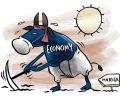
Fewer people participated in MGNREGA during the first six months of this financial year (April-September) compared to the same period last year, a recent analysis of the scheme's performance by LibTech showed.

Union Finance Minister Nirmala Sitharaman's call for making lending rates affordable may not resonate anytime soon as banks still struggle with margin compression, and await clues from the Reserve Bank of India (RBI) on liquidity and rate action. Hinting that any lending rate cut was some time away, State Bank of India (SBI) managing director Vinay M Tonse said there was still some aggression in the market regarding deposit pricing.

Analysts are warning of growing risks to the market's sustained momentum, and even to the possibility of consolidation at current levels. Domestically, markets are grappling with several challenges, including a slowing economy, as indicated by the latest GDP data for the July-September (Q2) quarter of 2024-25 (FY25), sticky inflation, fluctuations in the rupee, waning consumption, and high interest rates.

The ongoing fourth quarter earnings season, global factors and macroeconomic data would guide the trends in the equity markets this week, analysts said. Markets would also take cues from trading activity of foreign investors, rupee-dollar trend and movement of global oil benchmark Brent crude. "Domestically, the next batch of Q4 earnings reports will drive stock-specific movements, Hero MotoCorp, Larsen & Toubro, BPCL, State Bank of India, Eicher Motors and Tata Motors are some of the big names in the list and the next phase of voting," said Pravesh Gour, senior technical analyst, Swastika Investmart Ltd.

While liquidity in the banking system has turned surplus in the last few weeks, it could go back to deficit again, mainly due to corporate advance tax outflows. The net liquidity surplus of the banking system rose to touch Rs 1 trillion on Tuesday on the back of government spending, according to the data released by the Reserve Bank of India.

In a data-packed week, the domestic macroeconomic figures -- industrial production and inflation numbers -- along with global trends would dictate trends in the equity market this week, analysts said. According to experts, markets may face volatile trends due to high valuations. Equity benchmark indices Sensex and Nifty hit their fresh record peaks on Thursday. Besides, trading activity of foreign investors, movement of global oil benchmark Brent crude and rupee-dollar trend would also influence trading in equities.

Public sector banks (PSBs) have proposed the Finance Ministry their plan to raise Rs 54,800 crore through Additional Tier-1 (AT-1) and Tier-2 bonds in the current financial year (FY25), 37 per cent more than the Rs 39,880 crore raised in FY24

'I now see rates rising again, particularly after recent losses - especially the January wildfires in Los Angeles.'

HDFC Bank, Reliance Industries and ICICI Bank remained among the top mutual fund (MF) buys for the second consecutive month in September. MFs deployed a net of Rs 15,000 crore into these stocks during the two-month period (August-September), revealed Nuvama Alternative & Quantitative Research reports.

The gig economy market is expected to grow at a compound annual growth rate (CAGR) of 17 per cent to reach a gross volume of $455 billion by the end of 2024, according to a white paper by The Forum for Progressive Gig Workers. Estimates suggest the gig economy has the potential to create 90 million jobs and add 1.25 per cent to India's GDP (gross domestic product) over time.
Reliance Industries closed more than half a per cent higher after the company announced a proposed merger of media and entertainment assets of Viacom18 with Star India. Hindustan Unilever, Bharti Airtel, Tata Motors, ITC, Tech Mahindra and Axis Bank were among the laggards.

Major credit issuers, including the largest - HDFC Bank - have integrated their systems with the Bharat Bill Payment Systems (BBPS) for receiving credit card repayments via third-party applications.

Alternative investment funds (AIFs) have crossed Rs 5 trillion in terms of funds raised, while the investment commitments have surpassed Rs 12 trillion for the first time as of September, according to data released by the Securities and Exchange Board of India (Sebi).

The Fintech Association for Consumer Empowerment (FACE), the only self-regulatory organisation for financial technology/fintech (SRO-FT) companies, is aiming to secure membership from at least 75 per cent of players across all key fintech categories within the next three years, according to a senior executive. The total number of members in the organisation has increased to 110, up from around 60 when it received approval from the Reserve Bank of India (RBI) to operate as an SRO-FT in August.

Capital markets regulator Sebi has extended the deadline for implementation of rules related to mandatory confirmation or denial of market rumours by the top 100 listed companies. The deadline has been extended for the top 100 listed companies by market capitalisation to June 1 from February 1 this year at present, according to a circular by the Securities and Exchange Board of India (Sebi). For the top 250 listed entities, the rule will kick in on December 1, 2024, from the current requirement of August 1, 2024.

Who says romance is dead in the age of coronavirus?

rediffGURU T S Khurana answers readers' personal income tax queries.

Life insurers shifted their focus to selling high-value policies in October as the transition to new surrender value norms, effective October 1, limited their ability to roll out all products in their portfolio. This led to a 40 per cent year-on-year (Y-o-Y) drop in the number of policies sold in October. Additionally, distributors engaged in a fire sale of policies in September due to uncertainty about the impact of the new norms on their commission structures.

Certain foreign portfolio investors (FPIs), which operate as pooled investment vehicles (PIVs), may not be exempt from the additional disclosure mandates by the Securities and Exchange Board of India (Sebi) following an update in the standard operating procedures (SOPs) for custodians. An updated version of the SOPs has specified several conditions to be met for PIVs to benefit from the exemptions granted. These include no segregated portfolios, independent investment manager, and investors having pari-passu (equal) rights in the entity.
Equity markets will take cues from global trends and trading activity of foreign investors, while in the latter part of the week the first quarter earnings from IT majors TCS and HCL Technologies would guide investor sentiments, analysts said. Markets may consolidate after the record rally last week, experts added. "On the domestic front, the Q1 earnings season begins this week. Key companies such as TCS and HCL Technologies will release their earnings on July 11 and 12, 2024, respectively.

Private sector bank board members have urged the Reserve Bank of India (RBI) top brass to consider workload management of the boards as they feel there are too many issues that go to the boards for approval and the situation becomes unmanageable at times. The views were conveyed to the regulator on Monday in a conference of directors of private sector bank boards on the theme "Transformative Governance Through Sound Boards". RBI governor Shaktikanta Das, deputy governors Swaminathan J and M Rajeshwar Rao, and other senior officials of the central bank participated in the conference.

Equity markets may witness a gradual up-move this week with some volatility as both election and earnings season are nearing their end, analysts said, adding that global trends and trading activity of foreign investors would hold significance in dictating investors' sentiment. Benchmark indices, which had a record-breaking rally last week, would also track global oil benchmark Brent crude and the rupee-dollar trend. The monthly derivatives expiry on Thursday may also fuel volatility in markets.

Sebi has barred Ravindra Bharti Education Institute, co-founded by finfluencer and YouTuber Ravindra Balu Bharti, from the securities market and directed to deposit Rs 12 crore "unlawful gain" earned from the alleged unregistered investment advisory business. It has been directed to deposit the amount to an interest-bearing escrow account created specifically for the purpose in a nationalised bank. Additionally, the regulator has barred Ravindra Balu Bharti, his wife Shubhangi Ravindra Bharti and directors -- Rahul Ananta Gosavi and Dhanashri Chandrakant Gosavi -- from the securities market.

After two months of net outflow, foreign investors turned buyers in June, infusing Rs 26,565 crore in Indian equities, driven by political stability and a sharp rebound in markets. Looking ahead, attention will gradually shift towards the budget and Q1 FY25 earnings, which could determine the sustainability of FPI flows, Vipul Bhowar, Director, Listed Investments, Waterfield Advisors, said.

A teacher of a private coaching institute in Madhya Pradesh's Indore was stripped and beaten up on Wednesday by a group of people, who later took him to a police station for allegedly indulging in obscene acts with a 17-year-old girl preparing for NEET exam, an official said.

GST collection in May rose 12 per cent to Rs 1.57 lakh crore, the finance ministry said on Thursday. The gross Good & Services Tax (GST) revenue collected in the month of May, 2023 is Rs 1,57,090 crore of which Central GST is Rs 28,411 crore, State GST is Rs 35,828 crore, Integrated GST is Rs 81,363 crore (including Rs 41,772 crore collected on import of goods) and cess is Rs 11,489 crore (including Rs 1,057 crore collected on import of goods).

Life insurance companies reported a 13.16 per cent year-on-year (Y-o-Y) growth in new business premium (NBP), totting up Rs 30,347 crore in October, even as the number of policies sold saw a sharp decline. The growth was largely driven by strong performance from private sector life insurers.
Commissions paid to mutual fund distributors (MFDs) increased by over 20 per cent for most large fund houses in 2023-24 (FY24), driven by a sharp market rally and strong inflows. The largest fund house, SBI Mutual Fund (MF), which now manages nearly Rs 10 trillion in assets, paid Rs 2,025 crore to its major distributors - 21 per cent higher than the Rs 1,675 crore payout in 2022-23 (FY23).

The introduction of tax deducted at source (TDS) on income from central government securities and state bonds may not lead to a significant effect on retail participation, according to market participants. The Union Budget proposed that starting October 1, 2024, investors may face a 10 per cent TDS on investments in central government securities and state development loans (SDLs). "Last Budget, TDS on interest on securities was reintroduced.

'We may see even more restrictive policies during 2.0.'
Release of key macroeconomic numbers, monthly derivatives expiry, and global cues are likely to drive stock market movement this week, according to analysts. Markets will also be reacting to remarks made by the US Federal Reserve Chair Jerome Powell, they said. "This week, we expect the market to witness a gradual up-move with stock-specific action.

Seven journalists were incarcerated in India in 2021 and 2022, the highest in three decades.

'How many jobs will be created when you complete your course?' 'How many people will compete with you?' 'What is the minimum and maximum salary you can expect?' 'Which are the companies that will offer you a job?' 'What skills do you have to develop?' 'How long will it sustain?'

India's unemployment rate is at a record low and the country's labour market is undergoing a structural transformation, a report said on Tuesday. In the new report, the economists at the country's largest lender SBI also pitched for a "reinterpretation of old fashioned rhetoric" while looking at a subject like employment. "India's unemployment rate is at a record low, India's labour market is undergoing a deep structural transformation with self-entrepreneurship across all echelons and higher educational attainment emerging as key enablers," the report said.

India has slipped two places on the World Economic Forum's Global Gender Gap index to 129th place, while Iceland retained its top position in the rankings published on Wednesday. Within South Asia, India was ranked fifth after Bangladesh, Nepal, Sri Lanka and Bhutan, while Pakistan was ranked last. Globally, Sudan was ranked last on the index of 146 countries, while Pakistan slipped three places to 145th.

DIIs owned equities worth Rs 73.5 trillion, just 1.9 per cent less than FPIs. This marks a significant change from a decade ago.

Credit card spending in September recorded strong growth of 25 per cent year-on-year (Y-o-Y), marking the highest increase in six months. Even as many banks saw higher slippages during the July-September quarter of 2024-25, spending growth exceeded 20 per cent for the first time since February. According to the latest data released by the Reserve Bank of India (RBI), September spending reached Rs 1.76 trillion, compared to Rs 1.42 trillion in the same period a year ago. In August 2024, credit card spending was Rs 1.68 trillion.
